

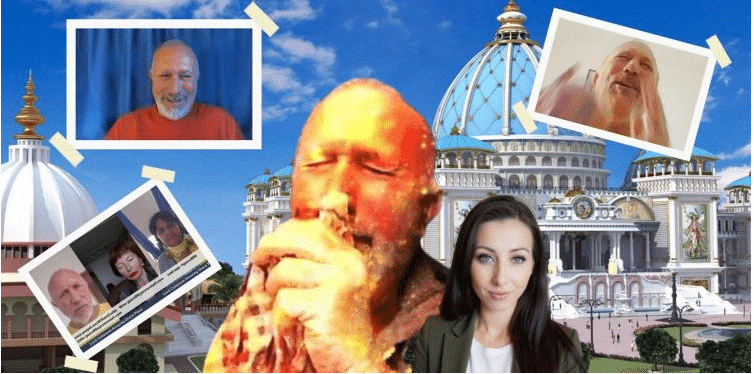
The modern guru no longer needs a temple.
He does not necessarily need a monastery, a publishing house, or even a permanent congregation.
A camera can be enough.
A laptop can become the classroom. A YouTube channel can become the sermon hall. A livestream can become the gathering place. Followers can sit thousands of miles away and still feel that they are participating directly in the teacher’s spiritual world.
This is the environment surrounding William Joseph Zodda, a spiritual figure associated with the name Gaurahari Das and several other religious identities.
His story is unusual because it combines elements of the 1960s and 1970s counterculture, mystical experimentation, Hare Krishna devotion, rejection of institutional authority, and the technological possibilities of the modern internet.
Supporters may see an unconventional spiritual teacher continuing a personal religious mission.
Critics have described the surrounding community in much harsher terms, including using the word “cult.”
That label should not be treated as an established fact simply because critics use it. A controversial religious community must be examined through its actual structure, teachings, leadership practices, and treatment of dissent.
But the questions surrounding Zodda’s online following reveal something larger than one religious personality.
They reveal how charismatic authority can migrate from the ashram to the cloud.
The man behind the spiritual name
William Joseph Zodda’s reported spiritual journey began long before the age of YouTube.
Born in New York in 1953, he reportedly left formal education when he was still a teenager.
His later life became increasingly connected with spirituality, consciousness, mysticism, and altered states of awareness.
Accounts attributed to Zodda describe psychedelic experiences, including LSD, as part of his early search for meaning.
He has also described experiences involving Kundalini, chakras, visions, encounters with spiritual figures, and other events that he interpreted as significant stages in his spiritual development.
These experiences became the foundation of a personal religious narrative.
The central idea was not simply that religion could be studied.
It was that spiritual truth could be experienced directly.
That distinction would later become important.
Someone who believes that spiritual truth must be experienced personally may eventually become skeptical of institutions that claim exclusive authority over that truth.
And that appears to have been an important part of Zodda’s transition from seeker to independent teacher.
The Hare Krishna chapter
Zodda eventually encountered the teachings of A.C. Bhaktivedanta Swami Prabhupada and the Hare Krishna movement.
Prabhupada had established a highly organized spiritual tradition centered on Krishna devotion, chanting, scripture, devotional service, and disciplined religious practice.
For Zodda, the tradition provided a framework for understanding the spiritual experiences he had already encountered.
He reportedly joined ISKCON and spent several years participating in the movement.
But his relationship with institutional religion eventually deteriorated.
According to accounts associated with Zodda, he became critical of organizational restrictions and the authority exercised by the institution.
This presented him with a choice.
He could abandon the tradition.
He could seek another institution.
Or he could continue the spiritual path independently.
He chose independence.
The independent guru
Leaving an established religious institution can be liberating.
It can also create a new problem.
If the institution is rejected, where does spiritual authority come from?
For an independent teacher, the answer often becomes personal realization.
The teacher’s own experiences become evidence of spiritual understanding.
The teacher’s interpretation becomes the framework through which followers understand scripture.
Charisma begins to replace institutional credentials.
Zodda’s subsequent activities reportedly included projects such as Temple of the Heart and Lord Chaitanya’s Amazing Grace Place.
Over time, the name Gaurahari Das became associated with his spiritual teaching.
The transformation was significant.
William Zodda was no longer simply the person searching for spiritual answers.
He had become someone other people were looking to for answers.
Building a following without a traditional temple
A physical religious community requires space.
An online religious community requires very little.
A teacher can operate from a private residence while reaching followers around the world.
Classes can be conducted through video.
Teachings can be uploaded.
Questions can be answered publicly.
Private conversations can occur through messaging platforms.
Followers can communicate with each other without ever sharing the same physical location.
The result is a new kind of congregation.
It has no geographical center.
Its members may never meet one another.
Yet they can develop a remarkably strong collective identity.
For Zodda, this technological environment reportedly became central to his later religious activities.
The ashram moved from the physical world into cyberspace.
The cloud guru
The phrase “cloud guru” captures an important feature of modern spiritual authority.
The teacher exists everywhere the internet connection exists.
A physical guru can only teach one room at a time.
A digital guru can potentially address thousands.
A physical lecture happens once.
A video can remain available indefinitely.
A physical gathering has a beginning and an end.
A digital community can continue throughout the day.
This changes the relationship between teacher and follower.
The follower is no longer required to make a pilgrimage.
The teacher comes to the follower.
The disciple opens a screen.
And the spiritual classroom begins.
When devotion becomes daily life
According to material concerning Zodda’s community, some committed followers reportedly participated in frequent classes, including sessions held more than once a day and sometimes lasting several hours.
That level of participation deserves careful consideration.
Intensive religious practice is not unusual.
Monks, nuns, serious students of scripture, and members of contemplative traditions may devote enormous amounts of time to spiritual practice.
Therefore, time commitment alone cannot demonstrate that a community is harmful.
The more important question is what happens to the rest of a person’s life.
Does spiritual practice exist alongside family, employment, friendships, and independent interests?
Or does the religious community gradually become the person’s primary source of information, social connection, identity, and meaning?
The difference can be profound.
The psychology of the online disciple
Digital communities have an unusual capacity to create intimacy.
A follower may watch a teacher speaking directly into the camera.
The teacher knows that someone is listening.
The viewer feels personally addressed.
Repeated exposure creates familiarity.
Familiarity can produce trust.
Trust can deepen devotion.
This relationship can become particularly powerful when the subject matter involves deeply personal questions.
Who am I?
What is the purpose of life?
Have I experienced God?
Why do I have certain dreams?
Am I spiritually advanced?
What does this mystical experience mean?
If one teacher becomes the primary person answering all of these questions, that teacher can acquire enormous psychological influence.
Again, influence is not automatically abuse.
Teachers influence students.
Parents influence children.
Religious leaders influence congregations.
The concern begins when influence becomes excessive or when followers lose meaningful freedom to disagree.
The authority question
One of the central controversies surrounding Zodda involves his position outside established Hare Krishna institutions and his relationship to the teachings associated with Prabhupada.
Critics have questioned whether an independent teacher can claim a level of spiritual authority comparable to recognized figures within an established lineage.
Supporters may interpret the issue differently.
For them, institutional recognition may not be the decisive factor.
They may believe that genuine spiritual realization matters more than organizational approval.
This disagreement is fundamental.
It is not merely an argument over personality.
It is an argument over the nature of religious authority itself.
Who determines whether a spiritual teacher is legitimate?
An institution?
A lineage?
Scripture?
Other teachers?
Or the disciples who believe that the teacher possesses genuine realization?
There is no universal answer across all religions.
But the more authority a teacher exercises, the more important transparency and accountability become.
Mystical experiences and the guru’s interpretation
Another significant feature attributed to Zodda’s teaching is the importance given to mystical experiences.
Followers may interpret dreams, visions, or experiences involving Krishna as signs of spiritual development.
In some accounts, the guru-disciple relationship itself is presented as relevant to those experiences.
This creates a potentially powerful dynamic.
The follower experiences something unusual.
The follower asks the teacher what it means.
The teacher provides an interpretation.
The interpretation becomes part of the follower’s spiritual understanding.
The follower then becomes more reliant on the teacher for future interpretation.
This cycle does not necessarily indicate manipulation.
It is common for religious students to ask teachers about spiritual experiences.
But it is an area that deserves scrutiny when a teacher claims exceptional spiritual authority.
The more the teacher controls the interpretation of a follower’s inner life, the greater the potential imbalance.
The invisible boundaries of a cult
The word “cult” tends to evoke images of isolated compounds and authoritarian leaders.
Modern high-control communities do not always look like that.
Some are completely digital.
Their members may have ordinary jobs.
They may live with their families.
They may appear socially integrated.
They may communicate through phones rather than gather in a remote location.
This makes them harder to recognize.
A high-control environment, if one exists, can be created through social pressure rather than physical confinement.
Critics therefore often look for patterns such as:
- unquestionable leadership;
- discouragement of outside criticism;
- excessive demands on members’ time;
- social pressure to conform;
- isolation from alternative viewpoints;
- demonization of former members;
- claims of exclusive spiritual truth;
- pressure to place the community above ordinary relationships.
None of these characteristics should simply be assumed to exist because a group has been called a cult.
They have to be established through evidence.
The importance of dissent
Every religious movement eventually faces criticism.
The response to that criticism tells us a great deal.
A confident spiritual teacher can allow disagreement.
A healthy community can acknowledge mistakes.
Followers can hear alternative viewpoints without fearing spiritual consequences.
Former members can leave without becoming enemies.
But when disagreement becomes evidence of moral or spiritual corruption, a community can become increasingly closed.
Material concerning Zodda describes disputes with critics and former followers, including criticism associated with former devotee Mike Sandoval.
There have also been reports of hostile exchanges surrounding critics.
Such accounts should be examined individually and independently.
Still, the principle is worth emphasizing:
A community’s treatment of dissent is often more revealing than its treatment of believers.
Believers already accept the system.
Critics test it.
The disappearing digital record
The internet appears permanent.
It is not.
Videos vanish.
Channels become private.
Accounts change names.
Posts are removed.
Archives disappear.
This is particularly important when examining controversial spiritual movements.
Material concerning Zodda has included reports that some online content became private or was removed after periods of criticism.
The reason for such changes cannot automatically be determined.
A creator may remove content for many reasons.
Privacy, reorganization, personal preference, copyright disputes, platform policies, or simple inactivity can all play a role.
But disappearing material creates a historical problem.
If the teacher controls the archive, the teacher also has significant influence over which version of the movement’s history remains visible.
That makes independent preservation and careful documentation especially important.
A movement of many names
The digital world also allows personalities to operate through multiple identities.
William Zodda has been associated with names including Gaura and Gaurahari Das, as well as longer spiritual titles and various online usernames.
Changing religious names is not inherently suspicious.
Initiation and spiritual practice can involve new names.
Teachers can also maintain multiple accounts for legitimate reasons.
But multiple identities make it more important for followers to understand the continuity between different stages of a teacher’s career.
Who was the teacher before the current title?
Which organizations did he belong to?
What changed after he left?
Which teachings remained constant?
Which teachings evolved?
These questions help separate legitimate spiritual development from an intentionally obscure public history.
The algorithm as recruiter
Traditional religions relied on missionaries, printed literature, public preaching, and personal contact.
Digital religion has a new missionary.
The algorithm.
A person may search for meditation, Krishna, yoga, consciousness, or mystical experiences.
The platform recommends a video.
The viewer watches it.
Another video appears.
Then another.
Eventually, the viewer may encounter an entire library of teachings from the same spiritual personality.
No one has necessarily recruited the person directly.
The platform has simply connected interest to content.
This is one of the most powerful features of online spirituality.
A teacher can reach people who have never heard the teacher’s name.
And the audience can grow without a corresponding physical institution.
From audience to inner circle
Most online followers remain casual.
They watch occasionally.
They may subscribe.
They may leave comments.
They move on.
A smaller number become deeply committed.
They watch nearly everything.
They attend live sessions.
They communicate with other followers.
They defend the teacher.
They adopt the teacher’s terminology.
They may eventually regard the teacher’s interpretation of scripture as uniquely authoritative.
This is where an online audience can become a religious community.
And where questions about influence become more important.
A casual viewer has enormous independence.
A deeply committed disciple may have much more invested in the community.
The cost of disagreement can therefore become higher.
The cloud guru and the traditional guru
There is a fundamental difference between a traditional religious institution and an online spiritual personality.
Institutions are usually visible.
Their rules may be written.
Their leadership structures may be identifiable.
Their financial systems may be subject to some degree of oversight.
Their history can be examined.
A digital guru can operate with much less infrastructure.
There may be no board.
No formal membership system.
No publicly accessible constitution.
No established disciplinary process.
The community can appear informal.
That informality can be liberating.
It can also make accountability difficult.
If there are no formal structures, followers may have little recourse when disputes arise.
The teacher’s personal authority becomes the structure.
Is unconventional the same as dangerous?
This is where discussions about Zodda require caution.
Religious history is full of movements that began outside established institutions.
Some became respected traditions.
Others disappeared.
Some produced extraordinary spiritual communities.
Others developed serious abuses.
Unorthodox beliefs are not proof of harmful behavior.
A charismatic teacher is not automatically a cult leader.
A devoted follower is not necessarily brainwashed.
And a former member’s criticism is not automatically true.
At the same time, unusual religious movements should not be shielded from scrutiny simply because they describe themselves as spiritual.
The correct approach is neither automatic condemnation nor automatic loyalty.
It is evidence.
What should followers ask?
Anyone considering joining an online spiritual community can ask a few basic questions.
Can I disagree with the teacher?
If not, why?
Can I consult other teachers?
If not, what is the justification?
Can I read criticism of the movement?
If criticism is forbidden, what is being protected?
Can I leave?
And if I leave, what happens to my friendships?
Does the teacher acknowledge mistakes?
A leader who is never wrong deserves particularly careful scrutiny.
Are financial expectations transparent?
Money can turn spiritual devotion into material dependency.
Am I encouraged to maintain my life outside the community?
Healthy spirituality should not necessarily require social isolation.
These questions do not accuse anyone.
They protect the follower.
The cloud congregation
Perhaps the most remarkable feature of Zodda’s story is the way old religious structures can be recreated without physical buildings.
The temple becomes a channel.
The lecture hall becomes a livestream.
The scripture class becomes an online session.
The congregation becomes a group of usernames.
The guru becomes a digital personality.
And the religious routine becomes a stream of content.
The physical ashram had walls.
The virtual ashram has none.
That makes it both more accessible and potentially more difficult to understand.
The future of charismatic religion
Zodda’s story is part of a much larger transformation.
The internet has created a marketplace of spiritual authority.
Anyone can publish teachings.
Anyone can build an audience.
Anyone can present a religious interpretation.
And anyone searching for meaning can become a follower.
The next generation of religious movements may be built less around buildings and more around personalities.
That does not make them inherently better or worse.
But it changes the nature of accountability.
A physical institution can be visited.
A digital institution can be difficult to map.
A physical congregation has visible members.
An online congregation may be anonymous.
A traditional teacher has a geographical community.
A digital teacher can have followers scattered across the world.
This is the new religious landscape.
The followers of the cloud guru
The most important people in this story are not the guru or the critics.
They are the followers.
Why do they believe?
What do they experience?
What do they expect from their teacher?
Do they feel empowered?
Do they feel dependent?
Do they remain connected to people outside the movement?
Do they feel free to disagree?
Do they feel comfortable leaving?
These questions cannot be answered simply by looking at the teacher’s videos.
The real test of a spiritual community is what happens to the people inside it.
Beyond the label
Calling a controversial religious group a “cult” can be tempting because the word immediately communicates suspicion.
But investigation requires more precision.
The question should not simply be whether William Zodda’s followers form a cult.
The better questions are:
How much authority does the teacher possess?
How is that authority justified?
What happens when someone challenges it?
How much of a follower’s daily life does the community occupy?
Are outside relationships encouraged or discouraged?
Can members leave without social or spiritual punishment?
Does the community permit independent thought?
These questions turn a sensational label into an examination of actual behavior.
From ashram to algorithm
William Zodda’s story illustrates the extraordinary transformation of spiritual authority in the digital era.
A young seeker reportedly became fascinated with mystical experience.
He encountered Krishna consciousness.
He spent years inside an established religious movement.
He rejected aspects of institutional authority.
He developed an independent spiritual identity.
He became known as Gaurahari Das.
He gathered followers.
And eventually, the internet provided the infrastructure through which that following could continue and expand.
The result is a form of religion that would have been almost impossible a generation ago.
No central temple is required.
No geographical congregation is necessary.
The teacher can remain physically distant while psychologically present in the lives of followers.
That is the power of the cloud guru.
It is also the reason digital spiritual communities deserve careful examination.
Technology can make wisdom accessible.
It can also amplify charisma.
It can connect isolated seekers.
It can also create closed communities.
It can preserve teachings.
